
How a Community Is Delivering More Than Food
Almost every time Kyle looks at the boxes, she feels emotional.
At Urban Ventures, Kyle is the Operations person who turns a new idea into a working system. When we realized the need for food delivery, she was the one figuring out how to move groceries, coordinate volunteers, and get boxes to the right doors without creating more fear in the process.
Much of what we’ve distributed has come through partner organizations, and we’re grateful. Those boxes are built for efficiency. They are effective, uniform, and they help us serve more families.
But these boxes are different.
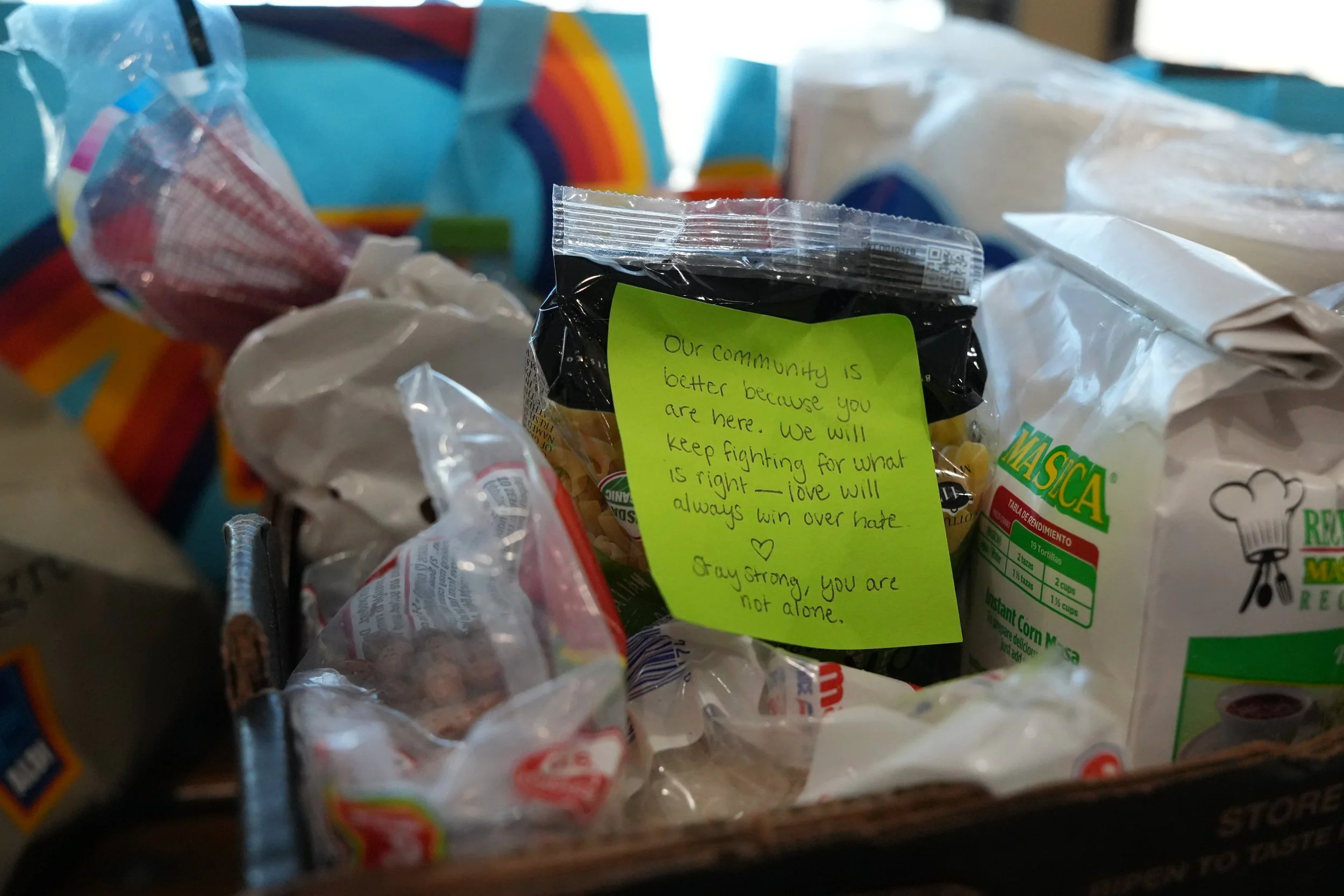
A donated box with a note
These are arriving one, two, four at a time. They’re packed by individual families in their kitchens, by small groups at their churches, by people who hear about what is happening in South Minneapolis and decide they need to do something. They drive them over on their own. They carry them in and set them down and sometimes they don’t even leave their names.
“There are so many voices right now telling our immigrant neighbors that they don’t belong here,” Kyle says. “That they’re not wanted. That they’re not a part of our community. And each box that’s packed by a family, by a small group, is a voice saying no. We do want you here. You are an important part of our community. And here’s one way of countering all of those ugly words that people are hearing.”
Every box is personal. Every box is a decision someone made, a trip to the grocery store, an evening spent packing vegetables and rice and oil into a cardboard box for a family they’ve never met.
One set of donated boxes arrives with handwritten notes tucked inside each one: Our community is better because you are here. Stay strong, you are not alone.
“I think those notes make explicit the love that is in each of those boxes,” Kyle says.
This isn’t the kind of generosity that arrives by the pallet. It arrives in trunks and back seats. A couple boxes here, a few more there. People wanted something tangible they could do, and this was it.
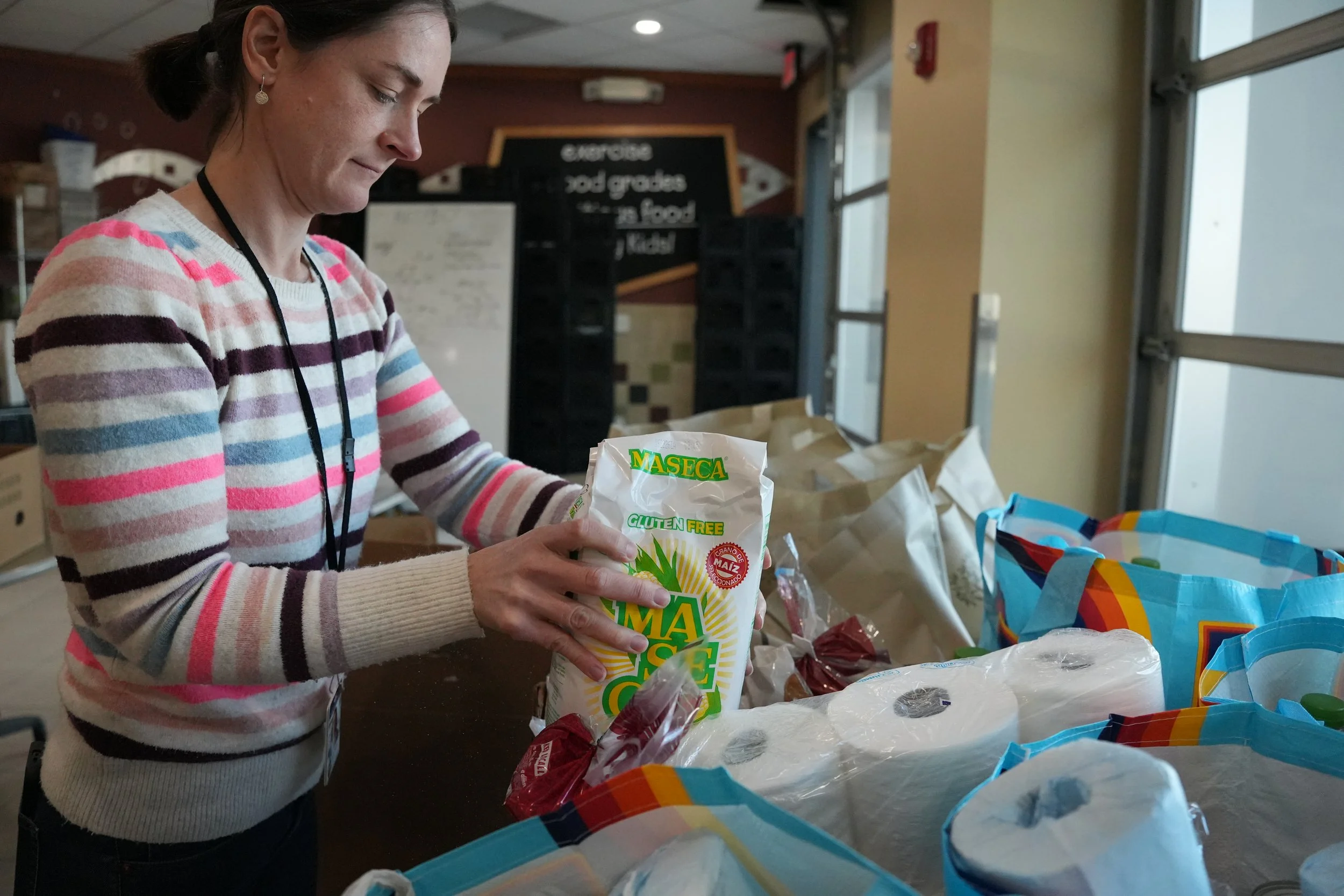
Kyle preparing a box for delivery
One donor came in one night with a few boxes, having bought much of what they needed at the Mercado right behind Urban Ventures. They'd spent over two hundred dollars on supplies. The shop owner, who has been struggling with low foot traffic, was so grateful for the business that he threw in cans of pickled jalapeños as a thank-you.
Kyle notices a receipt in one of the bags. "That funnels back to our community, too," she says. "That's a business that's kept open. That's people who are employed. That's local access to food when people leave their homes again."
One act of generosity, and it touches more lives than the receiving family will ever see.
•••
The same care is taken in delivering the boxes. Urban Ventures staff, along with some of our most trusted volunteers, drive routes bringing food to families who need it. Each week, the list grows. The drivers don’t complain.
“Almost every delivery volunteer has thanked me for the chance to help,” Kyle says.
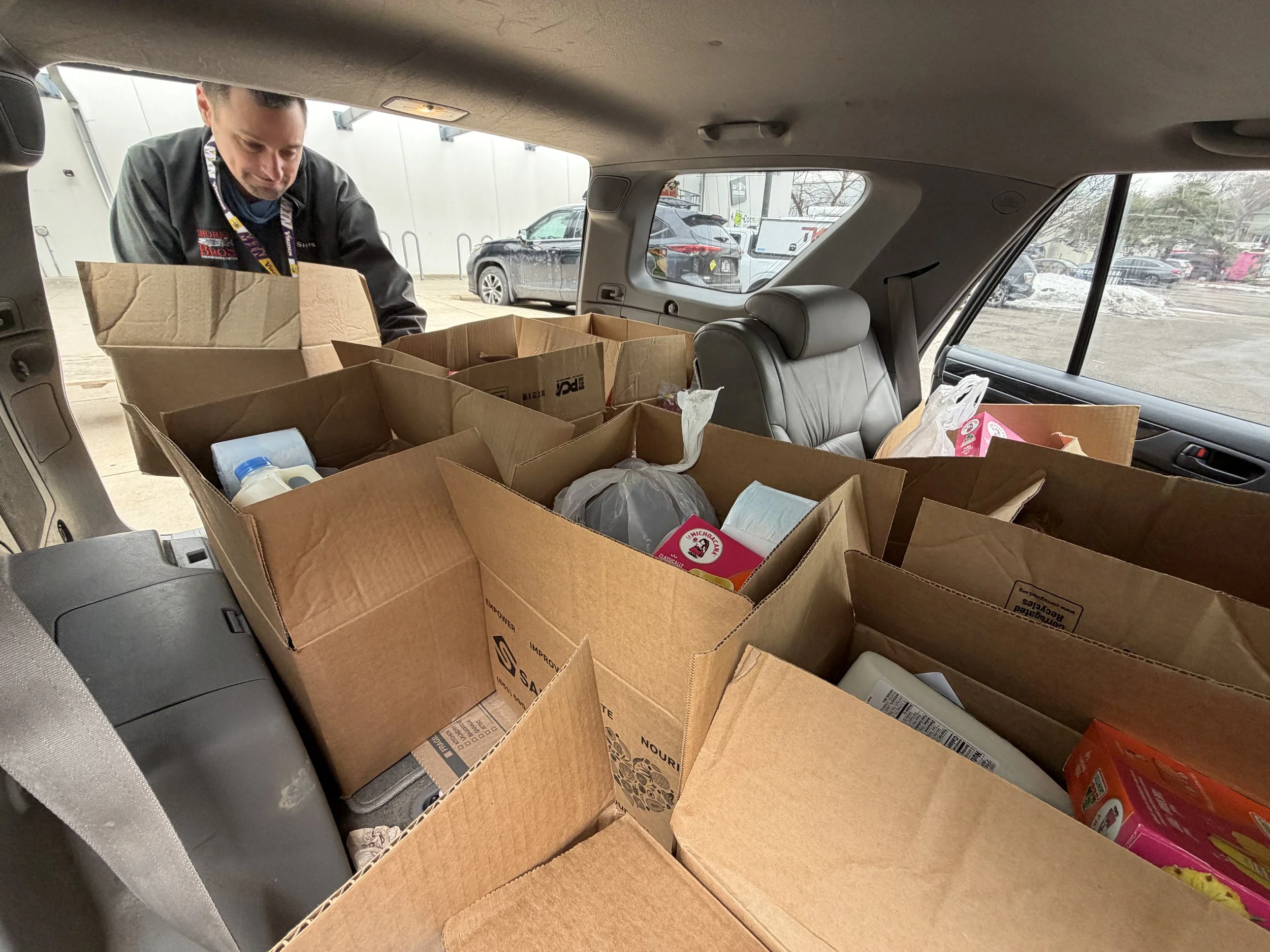
UV staff preparing a delivery
They range from college students to retirees, but the refrain is the same: This isn’t okay. I hate what’s happening. What can I do?
So they show up. They carried heavy boxes when sidewalks were sheets of ice. They loaded and unloaded vehicles when wind chills were below zero, climbing in and out of cars with arms full of groceries in weather that keeps most people indoors.
Before each delivery, Urban Ventures sends a message to families letting them know when a delivery is coming. A car they may not recognize. A person they may not know. There are legitimate reasons to be cautious right now, and the last thing anyone wants is to add fear to a community already saturated with it.
One delivery team pulled up to a house, and a man from across the street ran out to meet them. His wife works at a bakery, and he’d been watching from the window, waiting for them to arrive. He pressed fresh bread into their hands to thank them for what they were doing for his neighbors. He wasn’t even the one receiving the delivery. He just wanted them to know it mattered.
Sometimes the recipients themselves come to the door, and there’s a moment where a volunteer, a staff member, and a participant get to look each other in the face. Even when they don’t share a language, they can share a smile. God bless you. We stand with you. This is for you. Kyle describes the volunteers as self-sacrificing, but, she adds, grateful for the opportunity to do it.
•••
When asked about the impact on the families receiving the deliveries, Kyle pauses. “I think anything I could tell you would be secondhand,” she says. “Let me grab Myrna.”
Myrna is a primary contact for many Urban Ventures participants through the Siempre Padres program. She knows these families. She talks to them every day. When she begins to speak about the food deliveries, her eyes fill with tears before she says a word.
“When everything started, it was really hard,” she says. “Immigrants who are here came because they were fleeing difficult situations. They came to work. The majority are people who wake up at five in the morning and go to two, three jobs.”
She wants people to understand that the people being targeted are not who certain voices have made them out to be. They are people who built their lives around work, around family, around contributing to the places they’ve landed. And then suddenly, the fear they fled found them again.
“In one moment, we felt alone,” Myrna says. “Like, now what do we do? Where do we go?”
And then the support began to arrive.
Before the crisis, many families didn’t know their neighbors. Language barriers, cultural differences, and the ordinary isolation of daily life kept people apart. You might live on a block for years and not know the people next door.
But the deliveries changed that. A new sense of belonging took root, not only between families and volunteers, but between neighbors who hadn’t had a reason to connect before.
“There was a lot of depression,” Myrna said. “Some people shared how close to the edge they felt. I think the deliveries kept many from falling into something much darker. There were families who didn’t know how they were going to get through this. They didn't know where to go. And then people showed up and said, we’re here.”
The children feel it, too.
Myrna describes families waiting for delivery days with anticipation. It isn’t only about the food. It is the connection with the person who comes, the effort they put in, the cold they endure to be there. The kids can be heard shouting through the house when the car pulls up: The food is here!
For a child who has spent days inside, absorbing the fear of adults around them, that moment is enormous. Someone came. Someone carried a heavy box to the door. Someone smiled at them.
“Nothing bad can take away that great love,” Myrna says. “Even though things have been so hard, that great love and compassion and care, you can feel it.”
One afternoon, when Myrna dropped off food, one of the women handed her quesadillas. “Here’s for your family,” she said. Even while receiving, these families look for ways to give. It’s who they are.
•••
Through all of it, Myrna has watched something else grow: trust.
When Urban Ventures tells families a delivery is coming, they watch for it. They open the door for a face they’ve never seen, because they trust the message that came before it. Kyle mentions seeing it firsthand. She’s someone they don’t know, but because they’ve heard from Urban Ventures that a delivery is coming, they know she’s safe. That trust is not small.
It has been built over years of presence in this neighborhood. It is the product of showing up, of keeping promises, of being there when things are good and when things fall apart. And right now, that trust is helping carry families through one of the hardest seasons they’ve ever faced.
“Even though there are people who don’t want us here,” Myrna said, “look at all the people who do. As a community, we can say: they are with us.”
Something else happens through all of this, something Myrna calls a despertar, an awakening.
Myrna describes families rethinking what matters. Parents who have been working multiple jobs pause to ask: what do I really want for my children, for my family? How do I prepare for something like this if it happens again? They are learning from this community how to make a plan, how to be ready. And even those who may someday have to leave are asking a different question than they would have before: What will I take with me from everything I’ve learned here?
It is a shift from crisis to agency. From fear to intention.
•••
The food deliveries are not the whole story. Families who spent weeks unable to leave home, and children who absorbed that stress day after day, will need more than groceries to heal. The work of rebuilding stability and restoring a sense of safety is still in front of us. Food has a way of opening doors. This is just the start.
But here is what is also true: every box that arrives is proof that love can be made visible. Every volunteer who shows up in the cold is proof that being a neighbor is core to who we are. And every family that opens the door, takes the box, and offers a blessing back is proof that hope is still alive in South Minneapolis.
The work is not over. But neither is the love. And that steady love is what will carry us through whatever comes next.